A field guide
All About Yaks
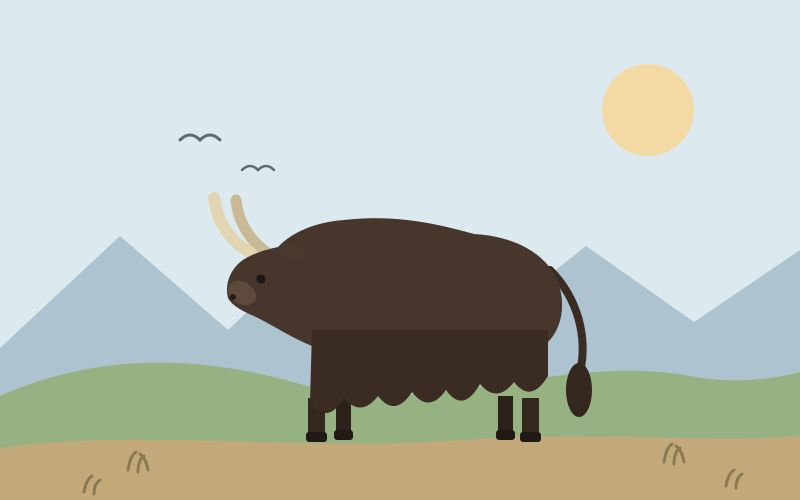
Long before cargo planes crossed the Himalaya, somebody's salt, tea, and household goods went over the top strapped to a yak — a huge, grunting, impossibly shaggy bovine built for a place where the air holds roughly half the oxygen it does at sea level. Yaks thrive where cows give up: on the Tibetan Plateau at 4,000 meters, in winter wind, on grass that grows for four months a year.
This site is a short, honest tour of the animal: what it is, where it lives, how it survives, and why millions of people across Central Asia still build their lives around it.
Yaks at a glance
- The yak
- A long-haired bovine of the genus Bos, native to the Himalaya and the Tibetan Plateau. The wild form is one of the largest land mammals in Asia.
- Scientific names
- Bos grunniens (domestic) and Bos mutus (wild) — "the grunting ox" and "the silent one." The names alone tell you which one you hear first.
- Altitude range
- Roughly 3,000–5,500 meters above sea level. No other cattle-like animal lives this high year-round.
- Survival kit
- A three-layer coat, oversized heart and lungs, and a reluctance to sweat. See how the body works.
- Day job
- Milk, wool, meat, fuel, and freight for an estimated 14 million domestic yaks — see Yaks & People.
What's in a name?
"Yak" entered English from Tibetan, but the word is a half-truth: in Tibetan, gyag refers to the male of the species, while a domestic female is a nak (or dri). So the animal most people picture — the one milked for butter tea — is technically not a "yak" at all in the language that gave us the word. European travelers heard the herders' word for the bull, generalized it to the whole species, and the rest is etymology.
Why do yaks grunt?
Nobody has run the definitive study, but herders and researchers point to the thin air: at these elevations, a low resonant grunt is an efficient way to be heard across a windy, treeless valley. The domestic yak's scientific name, Bos grunniens, literally means "grunting ox" — Linnaeus named the species after the sound. Wild yaks are quieter, hence Bos mutus, "the mute ox."